Aquarium water parameters explained: pH, ammonia, GH, KH
Updated
Aquarium water tests measure a handful of values. Ammonia and nitrite come from fish waste and should read zero in an established tank, according to many care sources. Nitrate is the much less toxic end product, and water changes keep it down. pH, temperature, GH and KH describe the water itself, and the right values for them depend on the species you keep. Always follow the instructions that come with your test kit.
The explanations below come from the Merck Veterinary Manual, written by veterinarians at the University of Florida, from RSPCA Australia and from the Ornamental Aquatic Trade Association (OATA). They’re general information, not targets for your tank.
The nitrogen cycle, in short
Fish excrete ammonia as waste, and uneaten food adds more as it breaks down. Beneficial bacteria, mostly living in the filter, turn ammonia into nitrite and then nitrite into nitrate (OATA: testing water quality). In a new tank, these bacteria take around 4 to 6 weeks to establish. RSPCA Australia describes a tank as fully cycled when ammonia and nitrite read zero while nitrate is being produced (RSPCA Australia: why water quality matters).
Ammonia
What it is: the main waste product of fish. Uneaten food adds more as it breaks down.
Why it matters: ammonia is toxic to fish. The Merck Veterinary Manual explains that the share of ammonia in its more toxic, un-ionized form rises as pH and temperature rise, with pH having the bigger effect (Merck Veterinary Manual: environmental diseases). Ammonia tests generally measure total ammonia nitrogen (TAN), both forms combined.
What sources say: OATA says ammonia and nitrite levels should always be zero.
Nitrite
What it is: the middle step of the cycle, made by bacteria from ammonia.
Why it matters: nitrite is also toxic. Absorbed into the blood, it forms methemoglobin, a condition known as brown blood disease, the Merck Veterinary Manual explains.
What sources say: zero in an established tank, as for ammonia.
Nitrate
What it is: the end product of the cycle.
Why it matters: nitrate is much less toxic than ammonia or nitrite, but it builds up over time. Partial water changes and live plants remove it, OATA notes. OATA doesn’t give one number for every tank and points to species care sheets for the level to keep.
A unit to check: some kits report nitrate-nitrogen (NO3-N) instead of nitrate (NO3). The Merck Veterinary Manual gives the conversion: NO3-N multiplied by 4.4 equals NO3. Check which one your kit uses.
pH
What it is: how acidic or alkaline the water is, on a scale where 7 is neutral, lower is acidic and higher is alkaline.
Why it matters: different species come from waters with different pH, and pH changes ammonia’s toxicity. OATA warns that sudden pH changes can make the water too acidic or too alkaline for your fish.
Temperature
What it is: the water temperature, read from a thermometer in the tank.
Why it matters: fish have very little ability to control their body temperature. The Merck Veterinary Manual stresses that a temperature in the right range for your species is critical, that tropical fish need a heater, and that sudden changes of even a few degrees can compromise their immunity (Merck Veterinary Manual: providing a home for fish).
GH (general hardness)
What it is: the amount of dissolved minerals, mainly calcium and magnesium. Aquarium kits often report it in degrees, dGH.
Why it matters: species are adapted to water of a particular hardness or softness, according to OATA. Your tap water sets the starting point, and the Merck Veterinary Manual notes that very soft water, such as deionized water, can cause poor growth.
KH (carbonate hardness)
What it is: a measure of carbonates and bicarbonates in the water, usually given in dKH. It’s closely related to what vets call alkalinity, which the Merck Veterinary Manual describes as the water’s buffering capacity.
Why it matters: buffering keeps pH from swinging. The Merck Veterinary Manual explains that filter bacteria slowly acidify the water. As the buffering capacity runs out, pH falls. GH and KH measure different things, so one doesn’t tell you the other.
Log your values in Aquarium Log
Aquarium Log records all seven: pH, temperature, ammonia, nitrite, nitrate, GH and KH. It doesn’t judge them. There are no “safe” ranges, warnings or colour codes, because the right values depend on your species and tank.
- On the Tank tab, tap Add test.
- Under Fill in only what you measured, enter the values you tested. Leave the rest as “—”, which means not measured. 0 means you measured zero.
- Tap Save.
Units: pH has no unit, ammonia, nitrite and nitrate are in mg/L, GH in dGH and KH in dKH, and temperature in °C or °F, set in Settings › Aquarium. Saltwater tanks log the same seven values, with no fields for salinity or reef parameters such as calcium or magnesium.
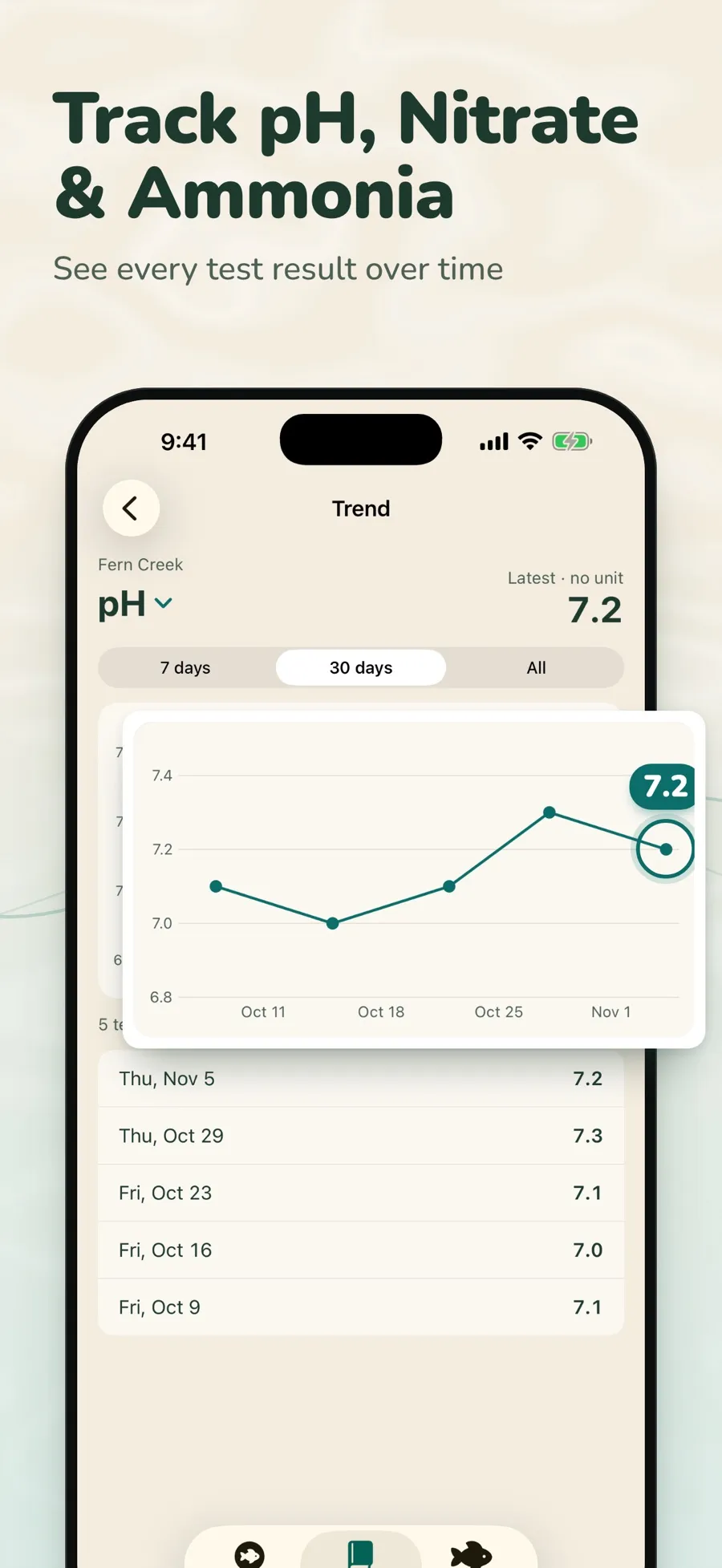
With Premium, tap a test in the Logbook and then Trend to see one value over 7 days, 30 days or all time. A slow drift is easier to see on a chart than in a list of numbers.
The download is free and includes water tests, the logbook and the care plan for one tank. Premium, a weekly or yearly subscription, adds trend charts, more tanks and a Home Screen countdown widget. It runs on iPhone and iPad with iOS 18 or later.
For a simple way to record readings, see how to keep an aquarium water test log on iPhone. To look up what a species needs, see how to check a fish’s temperature and pH range.
Quick answers
Should ammonia and nitrite be zero in an aquarium?
In an established tank, many care sources say yes. OATA says ammonia and nitrite levels should always be zero, and RSPCA Australia describes a tank as fully cycled when both read zero.
What’s the difference between GH and KH?
GH, general hardness, measures dissolved minerals, mainly calcium and magnesium. KH, carbonate hardness, measures carbonates and bicarbonates, which buffer the water against pH swings. They measure different things.
Why is nitrate less of a worry than ammonia?
Nitrate is much less toxic to fish than ammonia or nitrite, according to the Merck Veterinary Manual. It still builds up over time, and partial water changes and live plants help keep it down.
What pH should my aquarium be?
It depends on the species you keep. Look up each species’ range in a care sheet or a database such as FishBase, and keep pH steady, since sudden changes can stress fish.
Does Aquarium Log tell me if a value is too high?
No. It records your values and, with Premium, shows trends, but it has no safe ranges or warnings. Check your species’ needs and your test kit’s guidance.
